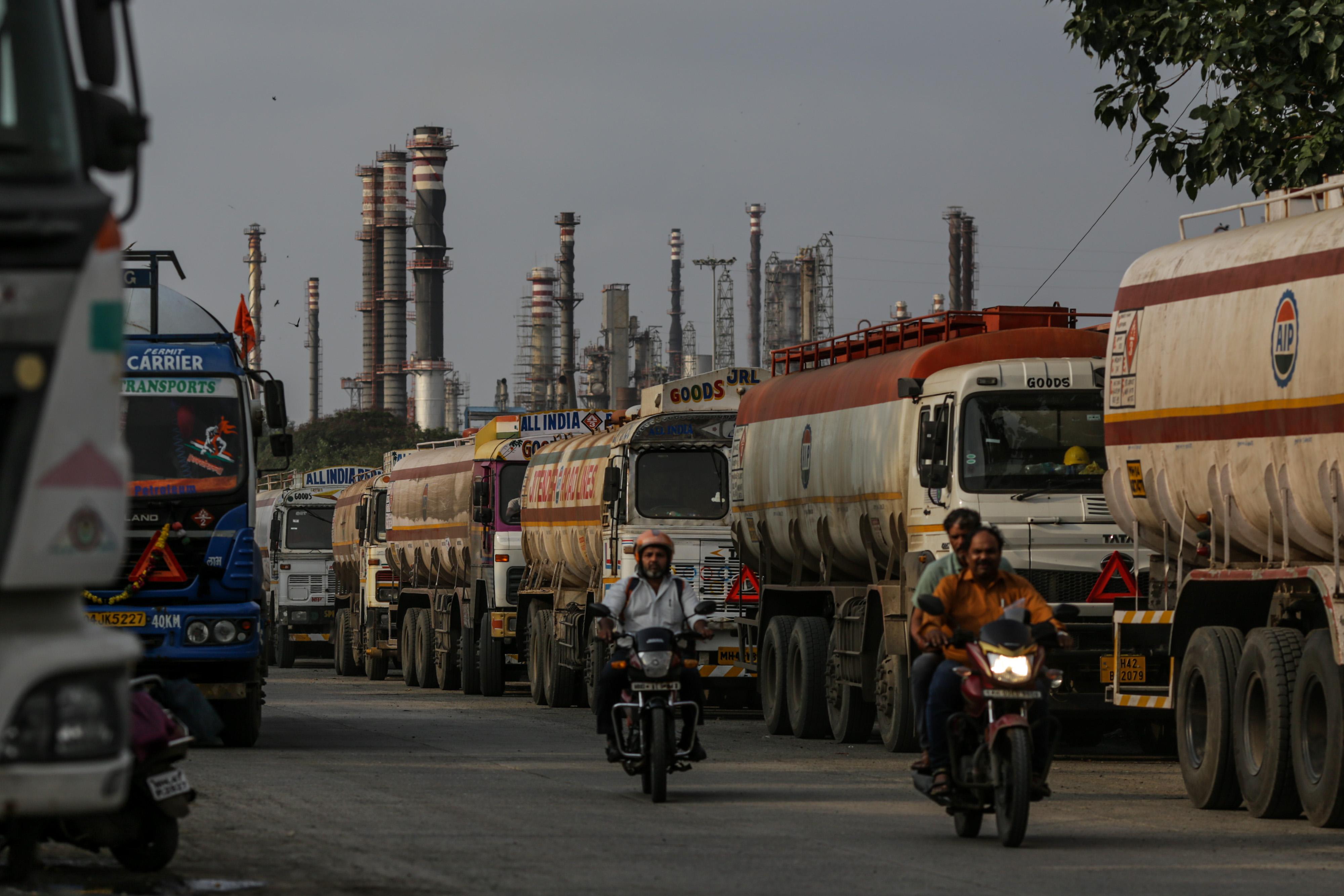
India puts a rover on the moon. It builds the world's largest digital payments network. But every single day, a tanker docks at an Indian port carrying gas this country did not produce, from a nation it cannot control, at a price it cannot negotiate. That country is Qatar — a state whose population is smaller than Bangalore — and it supplies nearly 40% of India's natural gas imports.
A country with a population smaller than Bangalore holds the energy leash of the fifth largest economy on earth.
This is not a new problem. It is a 75-year-old curse that every government has tried and failed to break. The standard response has always been the same: buy more, drill more, sign more deals abroad. The Modi government has now tried something different.
It has bet ₹37,500 crore of public money on turning coal into gas — a technology that has never been attempted at scale in India before. India consumes around 65 billion cubic metres of natural gas every year. It only produces 35 BCM at home. The 30 BCM gap has to be imported.
Qatar fills nearly half of that gap alone. What makes this dangerous is not just the import dependency — it is the concentration. One port shutdown, one diplomatic breakdown, one missile near the Strait of Hormuz, and half of India's industrial engine slows down overnight. "A country with a population smaller than Bangalore holds the energy leash of the fifth largest economy on earth."
Most people think natural gas is just for cooking and autos. It is also the backbone of six critical industries: fertiliser, pharmaceuticals, plastics, steel, glass, and ceramics. No gas means no fertiliser, which means farmers cannot plant the next crop. No gas means pharmaceutical factories run dry — insulin, antibiotics, paracetamol production halts.
Steel plants go idle. Construction freezes. India currently holds only 60 days of gas reserves. France holds 108 days.
China holds over 90. Germany holds 75. If Qatar shuts the tap for 30 days, the consequences are not abstract. Within a week, urea disappears from Indian villages.
Within two weeks, pharma factories run dry. Within three weeks, steel plants go dark. This is the real shape of India's gas vulnerability — and it is getting worse, not better, as the US pressures India to stop buying oil from Russia, Venezuela, and gas from Iran. So the government made a decision: stop looking outside.
The answer was sitting under India's feet all along. India has the fifth largest coal reserves on the planet — 200 years of supply. The Coal Gasification Mission, approved with a ₹37,500 crore outlay, aims to convert coal into synthetic natural gas. The target is to convert 100 million tonnes of coal into gas and cut LNG import costs by ₹80,000 crore.
"If this works, India will never panic during an oil shock. If it fails, ₹37,500 crore of taxpayer money disappears and 1. 4 billion people stay hostage to Qatar." The science is not new.
Coal is placed in a sealed chamber, pumped with limited oxygen and steam at 1,000 degrees Celsius. Given unlimited oxygen, coal burns. Given just enough oxygen — not enough to burn — it dismantles instead. Carbon and hydrogen atoms are pulled apart, recombined, and a gas called syngas comes out.
Syngas is a mix of carbon monoxide and hydrogen, and it is one of the most versatile molecules in modern industry. Rearrange its atoms one way and you get cooking gas. Another way and you get ammonia, which becomes fertiliser. Another way and you get methanol, which can replace petrol.
From one black rock, you can potentially supply six industries and bring imports to zero. China faced the same energy crisis 22 years ago and chose this path. Today, China's coal-to-gas production is approaching 30 BCM — exactly the size of India's import gap. If India had started this in 2003, it would need zero natural gas imports today.
