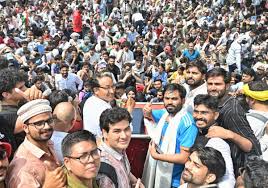
The Cockroach Janata Party has over 2 crore followers on Instagram. So when its first physical protest was called at Jantar Mantar, the obvious question was: how many showed up? It became the only question anyone wanted to answer — and in asking it so obsessively, most people missed the more important one. Young people came carrying posters of skeletons labelled "the examination system."
India's political history has never seen school children challenge a sitting Prime Minister and have him go silent in response.
Others demanded the resignation of Education Minister Dharmendra Pradhan. Some wore cockroach masks. One poster read: "How many more times will this paper-leak government return?" In 40-degree heat, with police outnumbering protesters in sections, they came anyway.
Whether the numbers were large enough to call it a success is a question each person will answer differently. But consider the context before answering. Since 2014, protesting in Delhi has been made to feel like a serious offence. Farmers were called terrorists and kept at Delhi's borders for two years — through winter, summer, and rain — barricaded by nails and barbed wire to prevent them from entering the city.
They never entered. They still forced the government to withdraw three farm laws and offer an apology. "India's political history has never seen school children challenge a sitting Prime Minister and have him go silent in response." Before the farmers, there were the citizenship law protests.
Students read the Preamble of the Constitution in public. Violence was engineered. And then the arrests came — not of those who caused the violence, but of those who had spoken against the law. Umar Khalid, Sharjeel Imam, Natasha Narwal, Devangana Kalita, Safoora Zargar, Gulfisha Fatima, Meeran Haider, Khalid Saifi, Asif Iqbal Tanha, Shafaa Rahman — their youth was spent in jail.
Some were inside for four years, five years, before getting bail. Some are still waiting. This is the air in which the Cockroach Janata Party called its first protest. The fear it asked young people to overcome was not imaginary.
It was built through years of watching what happens to those who speak. That fear is sitting in every household where a young person considers going to Jantar Mantar. Abhijeet Deepke, the young man who organised the protest, flew back from the United States to be there. He knew he could be arrested.
His mother and sister spent days crying — not when he left for America, but when he came back to India. As he put it: his mother's fear was not hers alone. It is the fear of every mother in this country whose child speaks against this government. "When a young man's mother cries harder at his return than at his departure, that fear is not personal.
It is political." The question of whether Abhijeet would have been able to do the same if his name were Mohammad Aslam is one that was asked — and left deliberately unanswered. Because as long as that asymmetry exists, one person's individual courage cannot be called a defeat of collective fear. Fear ends when anyone — Abhijeet or Aslam — can call a constitutional protest without being called a traitor, without facing jail, without their family spending nights in dread.
A few hundred young people at Jantar Mantar. Is that a flop or a hit? Many political parties and movements in India started with five people. Some grew into forces that changed governments.
Some collapsed. What matters right now is that they came. They chanted. They held their posters up in the heat.
And in doing so, they reminded a city that has been made to forget — that in a democracy, protest is not a crime. It is the point.
