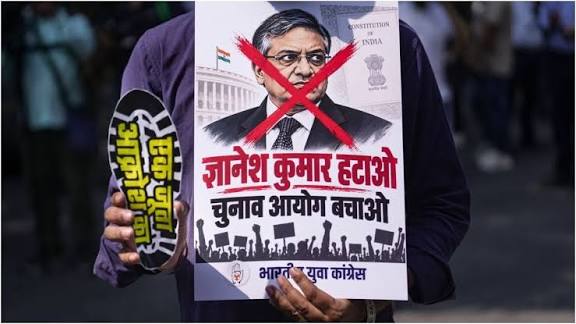
The selection committee received 212 names. Minutes before it met, the government handed over a list of six. Two officers made the cut, and one of them, Gyanesh Kumar, now runs India's elections.
Opposition parties and protesters demand that Kumar resign immediately. A dozen BJP chief ministers answered with statements and press conferences in his defence. Kumar spent 18 years in the Kerala cadre, as district collector and PWD secretary, before moving to Delhi by 2007. He joined the Home Ministry as Joint Secretary in 2016 and retired in January 2024. Two months later he was back at the centre of national politics.
Why would a ruling party defend one official so hard? The answer may lie in his record. Congress MP Adhir Ranjan Chowdhury asked how anyone could assess 212 officers overnight. Rahul Gandhi, the third member of the committee, objected to a midnight meeting where PM Modi and Home Minister Amit Shah picked Kumar. Kumar became Chief Election Commissioner a year after his selection.
The record of his Home Ministry years is where the story gets heavier. A book by the Blue Craft Digital Foundation, which works closely with the BJP and the Prime Minister, credits Kumar with a central role in the Article 370 plan that began in 2017. It says he kept the plan secret and prepared 12 drafts of the same bill. On August 5, 2019, he had to secure the President's signature on Constitutional Order 272, which moved the power to abrogate Article 370 from the J&K Constituent Assembly to Parliament. The bill reached the Rajya Sabha at 1:17 am, and members received the updated agenda after it had already been introduced. In January 2020, the Ayodhya desk also landed under him. The Ram Janmabhoomi Teerth Kshetra trust raised over ₹3,500 crore.
No RTI reply, no public information officer, nothing.
That is how the speaker described the trust's finances. Secrecy of that kind is the common thread, and the Election Commission now asks the country for trust on the same terms.
Kerala adds an older and unproven shadow. In 2006, a Malaysian company's project manager, Li Seedeen, was found dead near Kuala Lumpur, having died by suicide. A vigilance probe followed into a road project involving PWD officials. An RTI response from the Kerala Vigilance Department said the matter closed with no irregularities found. Former PWD minister Thomas Isaac claimed the suicide note named several corrupt officials, Kumar among them, and that Kumar was transferred afterwards. These could be political allegations. No document in the record confirms them.
Then came the SIR, the Special Intensive Revision of voter rolls, Kumar's first big announcement as Chief Election Commissioner. Millions scrambled for documents, and many were left off the rolls. In November 2025, his daughter Medha Rupam, an IAS officer, filed FIRs against 60 Booth Level Officers and 7 supervisors. A high court later ordered her to pay ₹5 lakh from her salary to a student she had detained under the National Security Act. The Supreme Court stayed that order, before a bench headed by Justice Satish Chandra Sharma, whose son is a standing counsel for the Election Commission. LiveLaw flagged the conflict of interest.
For a voter who spent days chasing paperwork to stay on the rolls, each link matters. The body that decides who votes is led by a man whose family appears in these disputes.
The Election Commission is bigger than one CEC.
Kumar's exit would remove a face. It would not explain why a bureaucrat from the Home Ministry's most politically sensitive desks, picked at midnight from a list of six, now holds the nation's electoral machinery. Dharmendra Pradhan was important to Modi and Shah, and they let him go. Whether they will do the same here is not the issue the institution has to answer.