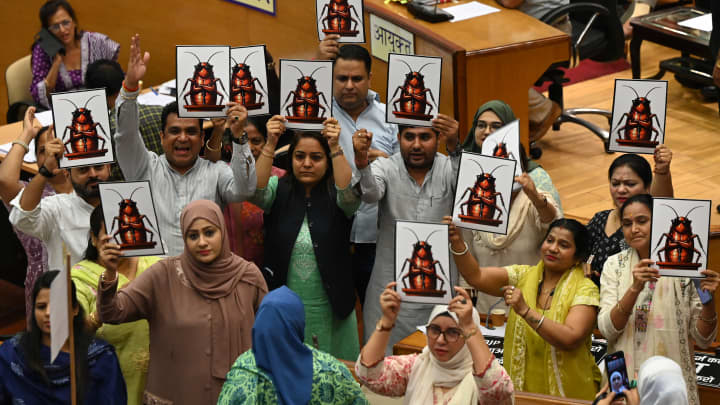
On May 15, 2026, a single sentence spoken inside India’s Supreme Court triggered a political storm few anticipated. During a court hearing, Chief Justice of India Surya Kant reportedly remarked that “youngsters are like cockroaches” while referring to fake degree holders and unemployable professionals. The Supreme Court later clarified that the comment was not directed at unemployed youth. But by then, the damage — or perhaps the awakening — had already happened.
A NEET aspirant often spends three to four years preparing, with coaching expenses alone crossing ₹1.5 lakh annually.
Within 48 hours, memes flooded social media. Videos amassed millions of views. And from that anger emerged something stranger: the “Cockroach Janata Party,” a chaotic but rapidly growing digital protest movement that turned an insult into a political identity.
The question is not whether the CJI intended to insult India’s youth. The deeper question is why millions of young Indians instantly believed the remark described them. Because the outrage did not emerge from one sentence. It emerged from accumulated humiliation. Over the past three years, India’s examination and recruitment ecosystem has faced one credibility crisis after another. National Testing Agency has repeatedly come under fire over NEET controversies, paper leaks and exam cancellations. UGC-NET was scrapped after alleged leaks surfaced online. UPPSC recruitment aspirants protested on the streets. CUET controversies triggered confusion across universities. Behind every scandal lies the same story — years of preparation destroyed overnight by systemic failure. For millions of middle-class families, these examinations are not merely tests. They are survival routes.
A NEET aspirant often spends three to four years preparing, with coaching expenses alone crossing ₹1.5 lakh annually. Families mortgage jewellery, break fixed deposits and take loans hoping education will deliver upward mobility. Then one leaked paper, circulated through WhatsApp groups or coaching networks, can erase four years of labour for 24 lakh students in a single night. And when those students protest, they are often told they are overreacting. That anger now intersects with a much larger crisis — the silent collapse of faith in India’s educational future. According to projections discussed by NITI Aayog, spending by Indian students studying abroad is exploding at an unprecedented pace. Nearly 18 lakh Indian students are now studying overseas, with annual family expenditure estimated in several lakh crores. Analysts warn that this is no longer just “brain drain”; it is becoming an economic transfer of India’s middle-class aspirations out of the country itself.
Every year, families sell land, liquidate savings and send children abroad not only for better salaries, but increasingly for something more basic — predictability. The numbers reveal the scale of desperation. More than 14 lakh students compete for roughly 17,000 elite engineering seats annually. In many entrance examinations, one seat attracts over 80 candidates. Economists and education analysts argue this is no longer competition in the conventional sense. It is elimination at an industrial scale. And that is precisely where “Cockroach Politics” begins.
Political analyst Yogendra Yadav recently described the phenomenon as potentially the beginning of a new youth political awakening. Others see it differently. They argue the movement may actually function as a “safety valve” — a digital mechanism that converts real anger into humour before it can become organised political pressure. The theory is not entirely unfounded.
India has witnessed large-scale protests force institutional responses before. Farmers’ movements compelled policy reversals. Recruitment protests forced governments to negotiate. Student agitations have historically shaped national politics. But meme-driven outrage often burns intensely online before disappearing without structural consequences.
That contradiction sits at the heart of the Cockroach Janata Party experiment. Its branding is undeniably powerful. Turning an insult into a symbol of resistance is politically effective. But critics argue branding alone cannot replace organisation, leadership or policy demands. Viral humour creates visibility; it does not automatically create accountability.
Yet dismissing the movement outright may also be a mistake. Every major political wave in modern history began as something fringe, emotional or even ridiculous before turning serious. The real issue is whether this anger evolves into sustained civic pressure — or remains trapped inside algorithm-driven entertainment. Because beneath the memes lies a devastating reality.
Youth unemployment in India remains alarmingly high, especially among graduates. Competitive examinations increasingly resemble lotteries. Government hiring remains sluggish. Private sector opportunities are uneven. And an entire generation now feels trapped between impossible competition, expensive education and shrinking economic mobility.
That is why the “cockroach” metaphor struck such a nerve. Not because young Indians literally believed they were being compared to insects — but because many already feel disposable inside a system that demands endless sacrifice while offering diminishing certainty in return.
The final irony may be the most uncomfortable one of all. A generation furious at being called “cockroaches” eventually embraced the word itself, turned it into a meme, printed it on posters and built a digital movement around it. Psychologists often describe this as a coping mechanism — reclaiming humiliation before it destroys self-worth.
But politically, it raises a dangerous question: does the system benefit more from youth anger or from youth satire? Because anger can organise movements. Humour often diffuses them. And as India’s examination scandals, unemployment anxieties and migration trends continue to deepen, the future of this so-called “Cockroach Politics” may ultimately depend on one thing — whether the country’s youth decides merely to survive the system, or finally attempt to change it.
