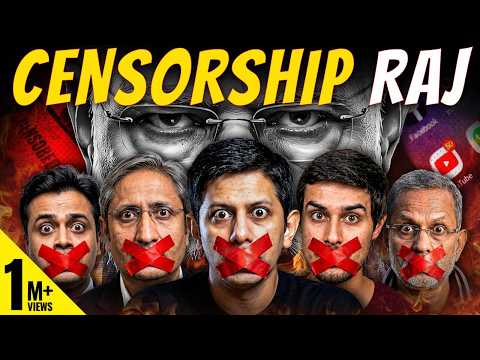
India likes to call itself the “Mother of Democracy.” But democracies are not defined by slogans—they are measured by how well they tolerate dissent.
The latest rankings from Reporters Without Borders paint a worrying picture. India has slipped to 157 out of 180 countries in the 2026 World Press Freedom Index, down from 151 just a year ago. It now ranks behind neighbours like Bangladesh and Pakistan, with only China placed lower in the region. This is not a one-off dip. It reflects a deeper, structural shift.
Criticism is not a weakness in a democracy—it is its foundation. Yet in India today, criticism is increasingly treated as disruption rather than democratic participation. Journalists report harassment, independent creators face takedowns, and platforms are flooded with content removal requests. The official response often dismisses such concerns, but the numbers tell their own story. Content blocking has surged from thousands in 2023 to tens of thousands by 2025. This is not moderation; it is escalation.
The real change lies in regulation. Earlier, content takedowns required due process—a written order, stated reasons, and oversight, as reinforced by the Shreya Singhal vs Union of India judgment. Now, proposed IT rule changes are steadily weakening these safeguards. The line between advisory and order is blurring, response timelines are shrinking drastically, and platforms risk losing “safe harbour” protection under Section 79 if they fail to comply.
The consequence is predictable: when in doubt, delete.
This is how modern censorship operates—not always through direct bans, but through pressure that makes resistance costly. The scope is also expanding. It is no longer just large media houses under scrutiny. A YouTuber, a satirist, or even an ordinary citizen discussing public affairs can now be treated as a “digital news broadcaster,” expected to follow the same compliance burden as established media organisations.
In theory, this creates accountability. In practice, it risks overreach. When content can be flagged for being in “bad taste” rather than unlawful, the boundary between regulation and subjectivity disappears. And once that line is crossed, self-censorship becomes inevitable.
The chilling effect is already visible. Creators and commentators are becoming more cautious. Satire softens, investigative work declines, and debate narrows. The most effective censorship is not enforced—it is internalised.
To be fair, the government’s concerns are not entirely misplaced. Misinformation, deepfakes, scams, and online abuse are genuine threats that require intervention. But intent alone is not enough—execution matters. When enforcement appears selective, targeting critics more visibly than harmful networks, the credibility of the system weakens.
India is at a turning point. Traditional media, in many cases, has softened its critical stance, while digital platforms have become the primary space for public discourse. Reports from the Reuters Institute indicate that a growing number of Indians now depend on social media for news. Controlling this space, therefore, has far-reaching consequences.
The question is no longer whether regulation is needed—it is. The real question is how far it should go.
The Supreme Court of India has previously upheld that free speech cannot be curtailed without due process. Civil society groups like the Internet Freedom Foundation continue to demand transparency and accountability. But institutions alone cannot safeguard freedom—public awareness and engagement are equally critical.
Because once the space for dissent shrinks, it rarely expands on its own.
A government that fears criticism eventually seeks to control it. And a system that controls criticism risks losing its legitimacy.
India still has the institutions and civic strength to correct course—but only if the problem is acknowledged.
Because if free speech begins to look like a threat, the problem may not be the speech.
