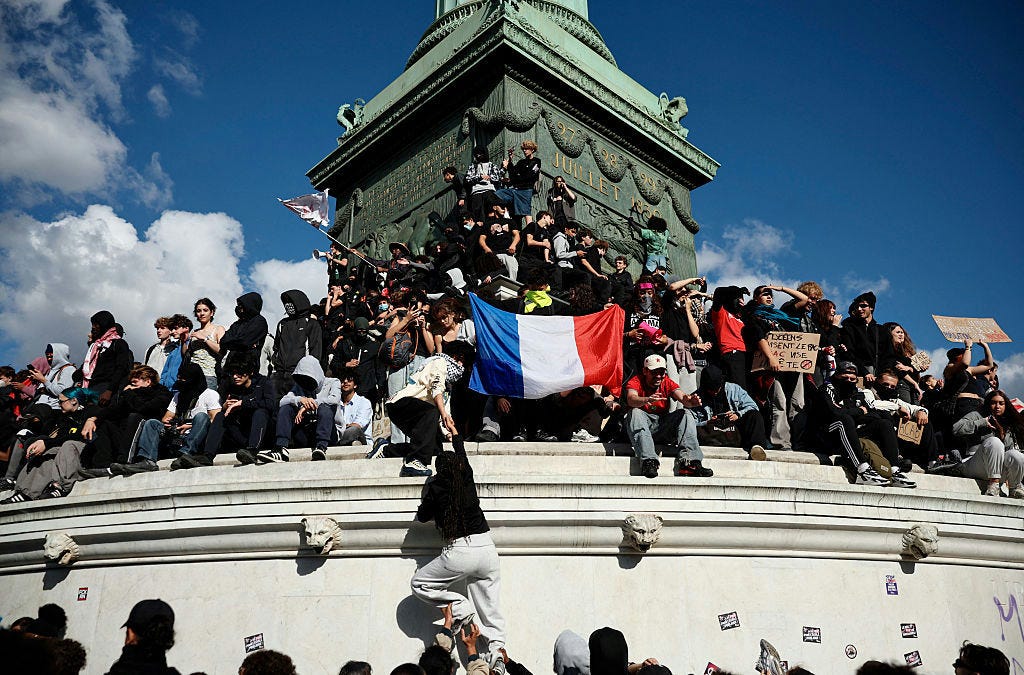
Europe spends up to 27% of its GDP on social security. The global average is 19%. And still, protesters are on the streets from Paris to Tirana.
The wealth is real. Nominal GDP per capita in the European Union is roughly $47,000, against a global average of about $27,000. These are welfare states: they pay for education, healthcare, housing and care for the old. The trigger for anger differs by country. In France, it was education reform. In Spain, affordable housing. In Italy and Portugal, rising inflation and house prices. In Albania, corruption. The spark changes. The frustration does not.
Why would young people in some of the richest places on earth feel this cheated? Start with growth. The global economy is expected to grow 3.1% this year. Europe will manage 1.1%. Without growth, governments have no new jobs, no new infrastructure and less money for public welfare.
Borrowing offers no escape. France carries debt of 115% of GDP, and investors have grown wary of lending to Paris. The yield on its 10-year bond hit 4.94% yesterday, the highest in 24 years. Governments can neither grow nor borrow their way out.
Without high growth, governments will not have the money to spend.
That sentence explains why a rich continent feels poor. A welfare state is a promise, and promises need a growing economy to pay for them.
Living costs add the second squeeze. Oil prices are 85% higher than at the start of this year. The speaker blamed Donald Trump's war on Iran for that jump and argued Europe could do nothing about it. The earlier shock was self-inflicted. In 2022, Europe cut off Russia, its nearest and most reliable gas supplier, to back Ukraine. The war still goes on. Ukraine has lost 20% of its territory. European inflation rose to 3.8% in September from 3.2% in August.
Then comes the security bill. For decades, Europe skipped serious defence spending because the Americans covered it. Trump tore up that arrangement and wants Europe to carry its own weight. The continent now plans to mobilise 800 billion euros, about $900 billion, over four years for fighter jets, air defences, ships, icebreakers and a larger army. That is money Europe already lacks.
Donald Trump tore up that book.
Washington's policy shift did not just change alliance politics. It sent a defence invoice to treasuries that were already unable to pay for pensions and housing.
Gen Z meets all of this at the age when political awareness forms. Experts tell them AI will take their jobs. Scientists tell them climate change will wreck the planet. Social media feeds them outrage, and older generations call them oversensitive. They feel governments are not doing enough, and they take that feeling outside. The speaker separated these protesters from the looters and rioters, a different group that every protest attracts.
The obvious fix is higher growth, and growth needs young workers. One in five Europeans is over 65. The fastest-growing group is those aged 85 and above. Young people, given this economy, do not want more children. Migration was the other route, and Europe tried it over the past decade. Integration proved hard, locals came to feel migrants were taking their jobs, and anti-immigration parties now win ground from France to Italy, Slovakia and Finland.
Protests are a message from the people to their governments.
Governments that answer with strategy papers, alliance calculations and great-power rivalry have misread the message. Policy has to serve the people, the speaker argued, not ideas or strategic goals.
Europe's leaders can loosen tech and investment rules, agree on migration and buy energy where it is cheap. None of that works while they refuse to hear what the streets are saying.