On 24 September, 10 cargo ships crossed the Strait of Hormuz. Before the war, about 125 large vessels passed every day. The route has not closed, but trade through it has thinned badly.
External Affairs Minister S. Jaishankar warned at the Asia Society and the UN General Assembly that the world is heading toward a big food crisis. Fertiliser is the link to India's farms. Fertiliser is not an optional extra in farming; it is a basic need. Between 25% and 35% of seaborne nitrogen fertiliser trade passes through Hormuz. Middle East producers make about 2 crore tonnes of urea a year, 35% of the seaborne total. India draws 20% to 25% of its fertiliser needs directly from the Gulf.
The Red Sea adds a second squeeze. Attacks on ships have pushed carriers off the Suez Canal route and around the Cape of Good Hope, adding 10 to 14 days to voyages reaching Nhava Sheva and Mundra. The Ukraine war has raised risk in the Black Sea grain trade, along with port, shipping and insurance costs. When a big supplier wobbles, buyers scramble for other sources and demand spikes.
India's exposure differs by product. Domestic plants produce over 85% of its urea, so import dependence is only 13% to 15%. For DAP it exceeds 60%. For potash (MOP) it is 100%. Which of those gaps can a country afford to leave open?
The World Bank reported that the global fertiliser price index rose more than 12% in the first quarter of 2026. Urea averaged $735 a tonne in March, roughly 55% above February, and the bank tied the jump to Hormuz disruptions. Indian farmers pay a fixed ₹266.50 for a 45 kg bag of urea, while the international price touched ₹4,000 a bag several times. A 50 kg bag of DAP costs farmers ₹1,350 against a global spot price above ₹5,000. The government pays the difference from its own budget.
Fertiliser is not an optional extra in farming; it is a basic need.
That is why an energy shock does not stop at the petrol pump. Fertiliser plants run on natural gas, so New Delhi placed them in the priority sector under the Natural Gas Supply Regulation Order. Diesel for tractors, power for pumps and trucks for the harvest all get dearer as well, and every rupee of subsidy is a rupee unavailable for other spending.
India built a cushion. Fertiliser stock stood at 180 lakh tonnes in March, about 39% above the 131 lakh tonnes a year earlier. By 22 June it reached 196 lakh tonnes. Against a Kharif requirement of 384 lakh tonnes, about 198 lakh tonnes was already stocked. That buys time, not immunity.
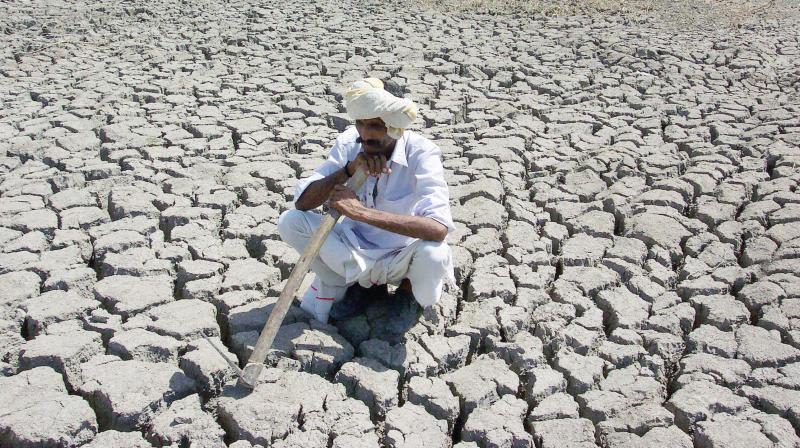
Then the Pacific enters. NOAA put the odds of a Super El Niño between October and December at 75%, and above 90% for a very strong El Niño this winter. Sea surface temperatures in parts of the East Pacific have run up to 3°C above normal, on a planet already 1.4°C warmer than pre-industrial levels. India's monsoon rainfall from June to September ended 12.6% below normal, which Reuters called the weakest in more than a decade. About half of India's farmland depends on that rain. The government cut its 2026 grain target to 373.93 million tonnes, 2.63 million tonnes below the seven-year estimate.
Prices already show it. The FAO Food Price Index hit 133.3 in August, its highest since late 2022, and sugar jumped about 12%. Food security is not just the grain that grows in a field. It means water, fertiliser, energy and transport arriving on time. Dearer food pushes up inflation, and that makes interest rate cuts harder for the Reserve Bank of India.
Not every signal points to disaster. India has diversified suppliers, pooled fertiliser purchases and kept wheat and rice stocks with the Food Corporation of India. Heavy rain also flooded parts of Uttar Pradesh in late September, so the problem is timing and place as much as shortage.
Food security is not just the grain that grows in a field.
A full godown does not irrigate a dry field or lower a village's diesel bill. India is not headed for a settled food crisis, but its safety rests on stock bought before the shocks arrived. When the stock runs down, the Pacific and the Gulf will still be there.