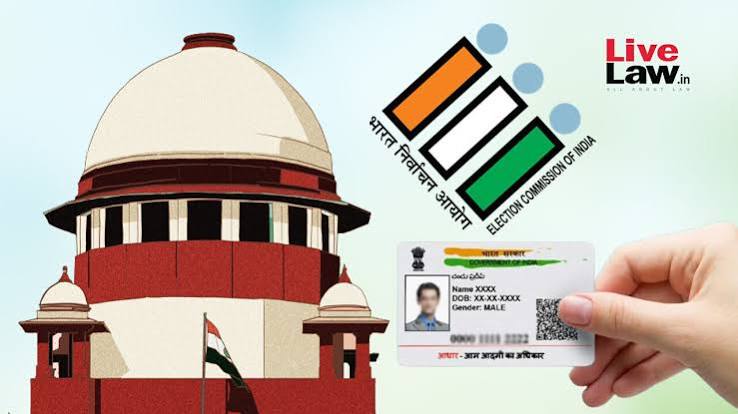
On 8 September 2025, the Election Commission added Aadhaar as the 12th accepted document for voters. In the same letter, it stripped the card of the one thing that mattered: it was proof of identity, not of citizenship.
The sequence began on 24 June 2025, when the Special Intensive Revision (SIR) order listed 11 documents and launched a pilot in Bihar. Bihar had 7.89 crore voters at the start. The draft roll of 1 August 2025 showed 7.24 crore, so 65 lakh names were gone. Petitioners told a Supreme Court bench led by Justice Surya Kant that poor voters held only Aadhaar or a ration card. On 8 September, the court ordered the Commission to accept Aadhaar.
The Commission complied on paper. Its circular also held that officials may verify the card's authenticity, and that it does not prove citizenship. So an Electoral Registration Officer can accept your Aadhaar and still doubt your citizenship because your name is missing from the 2003 list. Who benefits from a document that is accepted and discounted in the same breath?
Frightened voters did the rest. Millions rushed to hand their Aadhaar numbers to the Commission's database. The EPIC-Aadhaar linking made voluntary through Form 6B in 2022, after a long legal fight, became a survival necessity.
Then the numbers arrived. The SIR ran from 27 October to 4 December 2025 across nine states and three Union Territories. The national count fell from 50.99 crore to 45.81 crore, which is 5.18 crore names in weeks. Uttar Pradesh dropped from 15.44 crore to 13.39 crore, a loss of 2.05 crore voters, or 13.21%. Across 403 assembly seats, that averages about 500 deletions per seat. In 2022, more than 100 of those seats were decided by margins of 5,000 to 15,000 votes.
Behind the deletions sits AIRNET, which merged databases from 36 areas into a centralised record of over 92 crore voters. Two AI tools, DSC (Demographic Similar Entries) and PSC (Photo Similar Entries), flag duplicates by names and by faces. Rural constituencies hold hundreds of Mohammad Aslams and Sunita Devis, and many share fathers' names. The Commission has never published the false-positive rate for matching blurry, 15-year-old photographs.
Today the public must prove its legitimacy before the server of power.
In 1950, the first Election Commission carried registers to refugee camps and village doors and enrolled 17.30 crore people with no paper conditions, even though 85% of the population could not read. The state proved its duty to the citizen then. Now the citizen proves existence to the state.
The Level Playing Field breaks at the next step. In a written Lok Sabha reply on 25 July 2026, Law Minister Arjun Ram Meghwal confirmed that party-nominated Booth Level Agents verify entries and flag discrepancies. During the 45-day Claim and Objection Window, a party with booth-level analytics knows which lanes lost names, where to file Form 6, and where to file Weaponized Form 7 against rival voters as "shifted" or "duplicate". Regional parties often lack trained agents at half their booths. A migrant labourer who earns by the day has nobody at all.
Layer on the family-tree data, and the state gains 360 Degree Voter Profiling: Aadhaar, EPIC and AIRNET linked family by family, booth by booth. The speaker calls it a Surveillance Dividend.
The gap between a living citizen and a deleted data entry is now just one form and one algorithm.
Voters argue over EVM chips and slip counts on polling day. The decisive act happens about six months earlier, when a cursor moves and crores of names disappear without a lathi charge or a breaking-news banner. A Digital Data War does not need a polling booth. It needs one deleted entry for each voter, and in Uttar Pradesh there are 2.05 crore of them.