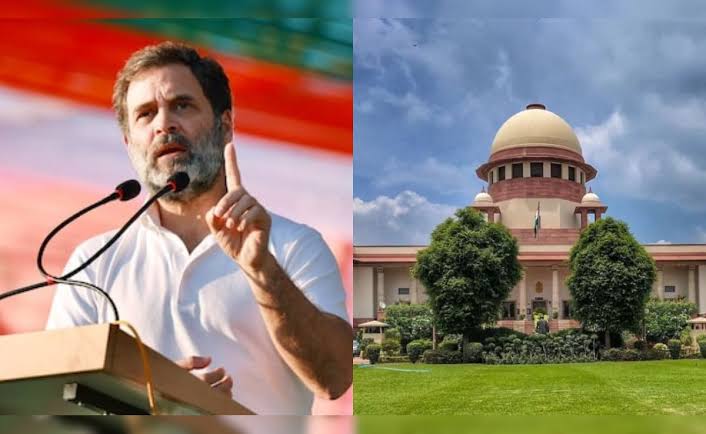
On Monday, opposition leaders marched towards the Supreme Court. On Thursday, the court asked the Leader of Opposition to explain himself.
The INDIA bloc leaders went to lodge a plea against the SIR process and Chief Election Commissioner Gyanesh Kumar. The bench headed by Chief Justice Surya Kant asked Rahul Gandhi to explain the intent behind the march and the disorder at the court. It issued notices to Gandhi, Mallikarjun Kharge, Akhilesh Yadav, Mahua Moitra and others over a breach of norms. The BJP seized on the court's remarks and accused Gandhi of trying to create anarchy.
Here is the contradiction. The same opposition that asked the court to rule on the SIR process also stands accused of crowding its doorstep. Senior advocate Mahesh Jethmalani argued that its lawyers described the courts as useless outside the courtroom, then returned to ask for a hearing on a Sunday. Is a litigant who distrusts the court entitled to its urgency?
The court's own words were firm. It observed that nobody can browbeat the judiciary and that there can be no mob entry into the court premises.
Nobody can browbeat the judiciary, and there can be no mob entry into the court premises.
The court did not wait for the political argument to finish. It named conduct, and it attached notices to that conduct.
A second plea cut the other way. Justice Bakshi and the Chief Justice issued notice on the de-notification of Jantar Mantar as a protest site. The court said it would examine whether the decision came after due application of mind and rested on an independent assessment of the site's suitability. It also sought documents, records and file notings on the Election Commission's SIR decisions. Jethmalani said the court could act on dissenting notes only if they showed a fundamental difference that affected the outcome. He pointed out that the Commission says its final decisions were unanimous.
On Jantar Mantar, Jethmalani held that Article 19(3) lets authorities regulate protest. He called Delhi's narrow roads unfit for large crowds and pointed to Ramlila Grounds, and to Shivaji Park in Bombay, as better venues.
The right of protesters ends where the rights of others begin.
That is a defensible rule on paper. It does not say who measures the harm to shopkeepers and commuters, or whether the police can declare it unilaterally. The court has now asked exactly that.
Brijesh Kalappa of the Congress argued that the government deployed 49,000 to 50,000 policemen against what he called a legitimate protest. Sanju Verma of the BJP replied that dissent is fine, even condemnation is fine, but not sedition, and she demanded action against Prashant Bhushan after his talk of regime change. Kalappa said Bhushan does not speak for the Congress. He also noted that Rahul Gandhi had said, "All protests are one. All protesters are one." That line is the very thing the Congress now has to explain.
The stakes reach working families and daily wage workers who cannot reach a courtroom at all. They need to know whether a street, a ground or a gate is theirs when a grievance has nowhere else to go. Jethmalani insisted the Supreme Court is the court of last resort. If the road to it is blocked at both ends, the phrase means little.
Jethmalani said the opposition lost the bypolls on the 9th, a day before its protest, and called its leaders poor losers. Kalappa cited Amit Shah saying the opposition would not be elected in '29.
People will believe the way you walk rather than what you talk.
Five states go to the polls next. Voters, not benches, will decide which story holds, and neither side seems to be waiting for the notices to be answered.