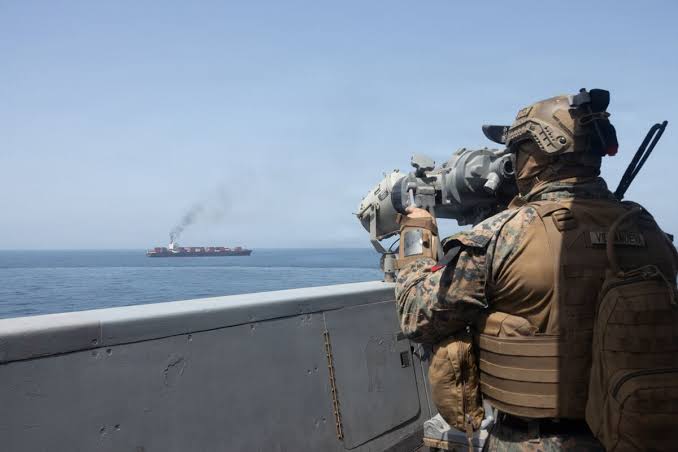
Eight months of blockade. A US fleet searching ships. And still, $2.3 billion in missile propellant and launcher chassis reached Iran. That is about ₹19,000 crore.
Leaked files and forensic records, which Reuters and international financial investigation agencies are said to have examined, trace the supplies to a government-linked entity coded MOD 346428. The cargo included solid fuel missile propellant, ammonium perchlorate and heavy missile launcher chassis. The blockade covers the Strait of Hormuz, the narrow corridor on which India depends for a large share of its needs.
The sanctions strategy rested on a simple belief. Swift cut Iran's central bank and major financial institutions off on 17 March 2012. On 5 November 2018, under the Maximum Pressure policy, Washington blacklisted more than 700 Iranian entities at once. Western planners assumed a country without dollars and bank accounts could not buy raw material for missiles. So why did Tehran's underground depots not run empty after eight months of war?
Because Iran's Defence Ministry stopped buying in its own name. Between 19 and 22, as the record puts it, Tehran erased its government name from its procurement system and built a trustee network. Private companies with no paper link to Iran made the purchases. The result was a syndicate of about 5,000 shell companies, and neither Washington nor Swift holds its key.
Money moved outside banks. Under the Sarafi net settlement network, exchange houses in the Gulf, Istanbul and Kuala Lumpur settle accounts without sending cash to Tehran. When a Chinese shell company buys Iranian crude cheaply, the payment sits in a local escrow account and pays a Russian or European supplier of industrial propellant. Gold bullion and petrochemical barter cover the risky gaps. Disposable corporate IT does the rest: when the US Treasury lists 50 of the 5,000 companies, about 100 dormant, pre-registered companies replace them within 72 hours. A researcher at the Royal United Services Institute named the structure the Hydra Syndicate.
A naval force standing in the ocean can surround the water, but it cannot surround the supply chain.
The blockade does cost Iran something. Washington and US Treasury officials argue the aim was never zero smuggling but a higher friction cost. When $1 of chemicals or chips must pass through three countries and five shell companies, the cost rises 35 to 45%. Yet Iran's new Supreme Leader, Mojtaba Khamenei, answered with the No Limits doctrine, which ends the restriction of retaliation to regional borders and proxy fronts. Strategists read that as a leader who believes the Hydra refills depots faster than war empties them. That defeats the White House attrition strategy on arithmetic alone.
Meanwhile Iran shows Doha a card. A secret deal under discussion there would reopen Hormuz within 48 hours, in exchange for conditions. Israeli Prime Minister Benjamin Netanyahu argues that waiting is suicidal and demands bunker-buster strikes on sites such as Pickaxe Mountain.
India feels every turn. If supply through Hormuz stops for even a few weeks, Brent crude could cross $110 a barrel. One Indian died after an attack on an Indian ship near Oman, the Ministry of External Affairs reported. Indian oil companies must buy more dollars, the rupee weakens, and the RBI spends more dollars to defend it. Foreign institutional investors then pull money from Indian equities toward US bonds. That reaches mutual funds, logistics costs and household kitchen budgets.
In the 21st century, wars are fought through corporate registries, dual-use goods, chemicals and shadow ledgers.
For a country of 140 crore people that imports most of what it needs and manufactures little, the government's approach has to feed all of them whether the strait opens or stays shut. Either way, India pays.
Nobody has shown that the sea patrol touches the pipeline behind it. India still imports through the one corridor where that pipeline's effects surface first.