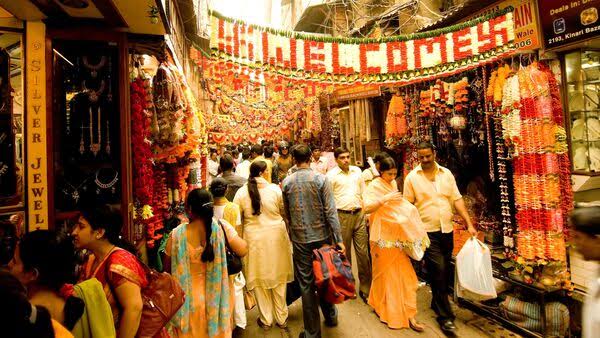
Urban Indian households plan to spend 6% less on Diwali than last year, a LocalCircles survey shows. The same survey found 83% of households will pay for the festival out of savings, because salaries do not cover household needs and no bonuses are expected.
Urban consumption has fallen 4% compared with last year, according to World Panel's October consumption report. The report found 84% of Indian households feel budget pressure. Only 16% of consumers say they are living comfortably, down from 28% a year ago.
Household spending growth has halved. World Panel data shows it has dropped to 7% from 13-14% in the previous year. Spending is shrinking in the categories households can postpone: 48% of consumers have cut back on entertainment, travel and shopping.
A festival budget paid from savings is not a sign of confidence. It is a household running down its cushion.
The rural picture is no firmer. World Panel data shows rural household spending rose 15%, but much of it is funded by loans and EMIs. A NABARD survey released in July found only 28% of rural households earned more than last year. Another 52.6% saw no change in income. 19.8% reported lower income.
The average Diwali budget is put at ₹20,000 per household. That figure includes families that spend ₹1 lakh on firecrackers. Among households that plan to spend, 57% in all, clothing and fashion top the list. Home appliances and furniture, and travel, are tied at 45% each. Food, sweets and gifts follow at 39%. 31% of households said they are not in a position to spend as they wish.
Economist Santosh Mehrotra says the weakness is not new. Consumption and demand deficits have run for 8 to 9 years, he says, because non-agricultural job creation is slow while more young people are educated and seeking work. Wages have not risen for regular workers, daily wage earners or the self-employed, he says.
When pay stands still and prices climb, families borrow to avoid sliding down a class. The bill arrives later.
Mehrotra says real wages, adjusted for inflation, have not risen in 8 years. Any festive boost lasting a month or two will fade, he says, and the economy will return to where it started. Nobody wants to slip from middle class to lower middle class, he says, so people borrow to keep their earlier standard of living.
Figures cited alongside the surveys point to the scale of that borrowing. Household debt is put at 45.5% of GDP. Non-housing loans make up 58% of household borrowing. EMI and interest costs take 13% of household budgets. The share of Indians holding a formal loan rose from 35% in 2017 to 74% in March 2026. These figures have not been tied to a published official dataset.
Wages in the informal sector, which employs 90% of workers, are put at ₹391 a day in manufacturing, ₹401 in trade and ₹420 in services in 2026. All three are below the ₹477 minimum wage benchmark for unskilled workers. No dataset for these figures has been published alongside them.
Spending that rests on loans and drawn-down savings cannot carry an economy through a festival season, let alone a year.
Growth has also slowed. Average GDP growth was 7.8% between 2004 and 2014, against 6.2% between 2014 and 2026, by the figures cited. When growth rises, savings and investment rise with it. Household debt has risen instead.
No government response to the wage stagnation or the shift to non-housing borrowing is on record. Who is responsible for wages that have not moved in 8 years, and what will households do when savings run out, remain unanswered.