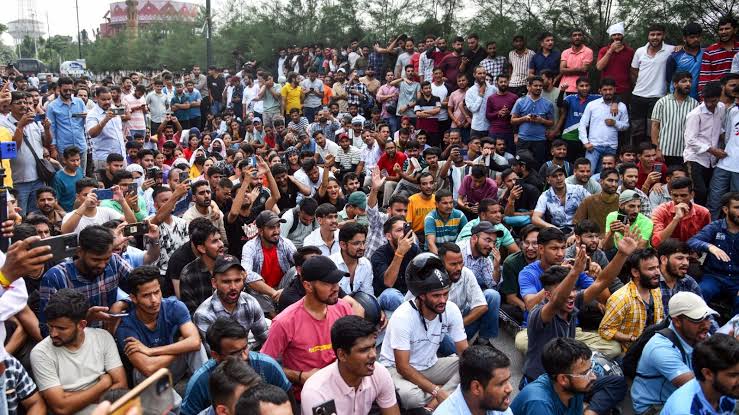
The government has deployed 25,000 security personnel against youth-led protests that began over leaked examinations, and protest leaders have been placed in judicial custody. Some of those detained are reportedly underage.
UN experts and Human Rights Watch have monitored the crackdown. Both have alleged that protesters were beaten and arbitrarily detained. The government says it is operating within the bounds of the law and that its restrictions are necessary to maintain public order.
The protests began as demands for the Education Minister's resignation after examinations were leaked. Around 20 or 21 children killed themselves after the exams they had prepared for were rendered meaningless, according to an account given by writer Atish Taseer. No official count of the deaths has been published. The minister has not resigned.
Around 20 or 21 children died after leaked exams voided their work. The minister still holds office.
The movement took its name from a remark by a chief justice, who described young people as cockroaches. Abhijit Dip K responded by calling himself a cockroach. Around 25 million people then came forward in solidarity, Taseer said. The figure has no official source.
Anger widened beyond the exams. Protesters raised the lack of jobs, the absence of economic mobility, healthcare and education facilities, and the conduct of the Election Commission. Taseer alleged that the protests turned against the Election Commission over the removal of voters from the rolls. The Commission says it is removing only ineligible voters, such as the dead.
The state's response has been physical and legal. Paramilitary forces, normally deployed on the border, were used against young protesters. Authorities have effectively closed Jantar Mantar in central Delhi, the capital's traditional protest site, as a meeting place. Mass arrests, heavy police deployments and internet shutdowns have been reported.
Forces meant to guard the border have been used against students. 25,000 personnel were sent to deal with young protesters.
Individual cases have drawn scrutiny. Taseer alleged that Dhruv Rathee was taken from his home without warrants or police identification and held at a safe house. No response from the authorities on this allegation is on record. Taseer also said actor Imran Khan, who attended a protest, was ordered to leave the country by the end of October and has reportedly been forced to apologise. No official order has been made public.
Prime Minister Narendra Modi has warned against "dimagi naxals", or intellectual insurgents, and called for them to be identified and isolated. The phrase echoes language used in 2019 about poets, lawyers and academics arrested under anti-terrorism laws.
The political fallout is contested. Rahul Gandhi has embraced the demonstrations and called for the removal of Modi and Home Minister Amit Shah. The BJP says the opposition has failed to present concrete evidence of voter suppression and is using the issue ahead of the 2029 elections. The BJP lost its outright majority in 2024 and governs through a coalition. Taseer said he saw no sign that any ally was preparing to withdraw support.
The government says its restrictions maintain public order. UN experts and Human Rights Watch allege beatings and arbitrary detentions.
No inquiry into the leaked examinations has been reported to have reached the Education Minister. No official response to the UN experts or Human Rights Watch is on record. Who will answer for the exam leaks, and who will answer for the detentions?